|
|
|
Hosuing of Animals
|
|
Sheep and goats form an integral part of the rural economy of the country. As they provide wool, meat, milk, skin, hair and manure. In general for sheep and goat, a well-established shed is not required when compared to dairy cattle, is needs simple shelter
|
|
Types of Housing
|
|
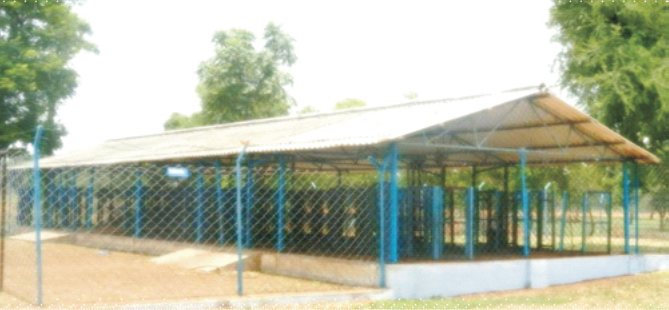
Open shed
|
|
It requires no special construction work except for roof and fencing. It requires only simple shelter with fences. During severe winter and summer time, we can provide some artificial protection with the help of gunny bags, bamboo, straws.
|
|
Semi-open shed In this three walls are closed, one side kept opened for free movement of flock.
|
|
Enclosed shed Environmentally controlled shed for light and ventilation
|
|
Floor Space Requirements
|
|
Types of animals
|
Minimum floor space per animal
|
|
Ram or buck in groups
|
1.8
|
|
Ram or buck - individual
|
3.2
|
|
Lambs or kids - in group
|
0.4
|
|
Weaner in groups
|
0.8
|
|
yearling or goatlings
|
0.9
|
|
Ewe or doe in groups
|
1.0
|
|
Ewe with lamb
|
1.5
|
|
|
Housing Systems
|
|
I. Loose housing
ii. Elevated housing
-
Its initial investment is high.
-
In the wooden floor sheds, in a distance of 3m from the floor, the animals are reared.
-
This requires less labour and more irrigation land for the fodder production.
-
The elevated sheds will be clean and urine and dung will be collected in the floor and periodical removing is required once in six months
|
|
Feeding & Water Space Requirements
|
|
Type of animal
|
Space per animal (cm)
|
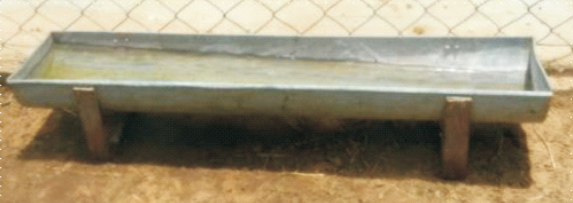
Width of manger/ water trough(cm)
|
Depth of manger/water trough (cm)
|
Height of inner wall of manger/water trough (cm)
|
|
Sheep and goat
|
40 - 50
|
50
|
30
|
35
|
|
Kid/lamb
|
30 - 35
|
50
|
20
|
25
|
|
×
![]()
|
×
![]()
|
|
Selection of Site
|
- The flooring may be either of moorum or of strong wooden battens and, where the rainfall is quite heavy; the latter type of flooring may be preferred.
- In the case of wooden-batten flooring, the width of each plank shall vary from 7.5 to 10.0 cm and the thickness between 2.5 cm and 4.0 cm.
- The sides of the planks shall be well rounded and the clearance between two planks shall range between 1.0 cm and 1.5 cm to facilitate the disposal of dung and urine.
- The wooden-batten flooring shall be constructed at a height of at least one metre above the ground level.
- In this case, a suitable ramp or steps of wooden planks shall be provided.
- In the case of moorum flooring, a plinth wall between 15 cm and 30 cm in height shall be provided.
- For the shearing and store room and shepherd's house, the flooring may be of moorum or brick in cement mortar, and the floor shall be levelled properly.
|
|
|
Different Types of Sheds
|
|
Ewe/Doe shed
These sheds shall be used for housing ewes or doe kept for breeding purpose. The shed shall be 15 x 4m size and 3m high and should accommodate not more than 60 ewe or doe.
|
|
Ram/Buck shed
The ram or buck shed shall be used for housing rams or bucks kept for breeding purpose. The shed shall be 4 x 2.5m size and 3m high and should accommodate not more than three animals. The shed shall be partitioned length wise to form three equal compartments. The partition may be made up of wooden planks. The partition shall be not more than one meter high from the floor. In the partition there should be a gap of 10 to 15cm between each plank to enable the rams or buck to see one another.
|
|
Lambing/Kidding shed
These sheds shall be used as maternity room for ewes and doe. The shed shall be 1.5m x 1.2m size and 3m high. A manger for holding feed hay and a bucket for keeping water shall be provided in the shed
|
|
Lamb/Kid shed
The lamb or kid shed shall be used for housing lambs or kids until they attain maturity. The shed shall be 7.5 x 4m in size and 3m high to accommodate not more than 75 animals. The shed shall be partitioned breadth wise dividing it into two compartments. The compartment having dimensions as 5 x 4m shall be used to keep the un weaned animals and the other compartment having dimension of 2.5 x 4m shall be used for keeping the weaned but immature animals.
|
|
Shearing shed and store room
The shearing and store room may consists of two compartments with a dividing wall one room may be exclusively meant for storing wool and shearing equipment and the other for keeping feed and medicines. The room may be 6 x 2.5m size and 3m high. There shall be a door 1 meter wide and 2 meters high in the front side of the room. One holding pen for at least 30 sheep in front of the shearing shed and another holding pen behind the shearing shed may be provided to hold shorn sheep after shearing.
|
|
Shepherd shed or house
The shepherd’s house meant for the caretaker shall be located at a convenient place in the yard. The house may be 6 x 4m size and 3m high
|
|
Sick animal shed
|
- This shed is for segregating ailing and disabled animals.
- It should be constructed away from the other sheds with a dimension of 3m (l) ×2m (w) × 3 m (h)
- The lower half of the door may be made of wooden planks and the upper half of wire-netting.
- There may also be a window of 0.7 m broad and 1.2 m high with a wire net covering.
|
|
Dimensions of different sheds
|
|
S.No
|
Name of the shed
|
lx w x h (m)
|
No. of animals Housed
|
Remarks
|
|
1
|
Ewe/ doe shed
|
15 x 4 x 3
|
60
|
-
|
|
2
|
Ram/ Buck shed
|
4 x 2.5 x 3
|
8
|
Make partition length wise
|
|
3
|
Lamb/ kid shed
|
7.5 x 4 x 3
|
75
|
Make partition width wise
|
|
4
|
Lambing/ kidding shed
|
1.5 x 1.2 x 3
|
1
|
Provide manger and waterer
|
|
5
|
Isolation / sick animal shed
|
3 x 2 x 3
|
1
|
Provide proper ventilation and bedding materials
|
|
6
|
Shearing shed
|
6 x 2.5 x 3
|
1
|
Make arrangement for storage of wool
|
|
7
|
Shepherd house
|
6 x 4 x 3
|
-
|
It should be located nearer to flock
|
|
|
Disinfection
|
|
Dipping tank
|
|
The dipping tank, to protect the animal from infection, may be either of galvanized steel sheets or constructed of stone or brick in cement mortar, whichever is likely to economical according to local conditions.
|
|
Foot-bath
|
|
A footbath made of galvanized steel sheets, or brick in cement mortar shall be provided at the entrance to the yard to protect the animals form foot-rot disease. These baths may be embedded in the soil suitably.
|
|
Milch doe shed
|
|
The shed shall consist of stalls for keeping milking doe. The stalls may be arranged in two rows with a passage in between them. The dimensions of each stall meant to keep a single milking doe may be 1.4m length and 1.2m wide (1.4 x 1.2m). The length of the shed shall depend upon the number of milking doe kept for milk production.
|
|
|
|
|
|